





Dangerous goods transport
2012-03-02
Dangerous goods shipping documents
1, checked when the dangerous goods manual provided with the consignment note in English or dangerous goods technical specifications of a type number of copies should name, aliases, molecular formula, properties, transport considerations, first aid measures, fire fighting methods for the port, ship loading and unloading, transport of dangerous goods reference.
2, the consignment must be accompanied by the examination and approval by the harbor superintendency administration, "the packaging of dangerous goods safety appropriate transport declaration (referred to as: cargo declaration), the ship agent with the ship by virtue of the declaration (goods to declare) again shall acquire ships carrying dangerous goods declaration form (referred to as: cargo declaration), port authorities must be received by the harbor superintendency administration examination and approval of goods to declare, before allowing the ship carrying dangerous goods.
3, The consignment should be submitted issued by the Import and Export Commodity Inspection Bureau of the IMDG Code in accordance with international maritime requirements for the packaging of dangerous goods certificate "qualified" by the various experimental results. The certificate shall be subject to Port Authority and stamped consent effective port operation area by the Port Authority and stamped certificate agreed dangerous goods into port and check the goods before clearance of the shipment, the harbor superintendency administration with the packaging clearance certificate for the goods declaration (2).
4, containers carrying dangerous goods must fill in English in container shipment of dangerous goods packing certificate "a type number of copies distributed to Port, ship, ship agents and harbor superintendency administration.
5, The outer surface of dangerous goods must display the << International Maritime IMDG >> dangerous goods signs and markings, signs and markings pattern specific need to see the schedule of the IMDG Code; group packaging or containers of dangerous goods, in addition to outside the cargo box to post signs and markings, in the packaging or container external four weeks needed to affix the same with the box contents of the cargo of dangerous goods signage and markings.
6, exports to the U.S. or in the United States for transshipment of dangerous goods, shipping should be provided in Chinese and English "dangerous goods safety information card (referred to as: MSDS) for a duplicate by the shipping agent to the carrier at U.S. ports for the record. Dangerous goods safety information card is required to fill: an overview of hazards composition, physical properties, fire and explosion data, health hazard data, reactivity, infiltration overflow, special protective measures, special methods of prevention and other nine elements.
7, tank container shipment of dangerous goods in bulk, must provide a certificate of inspection of tank containers.
8, the United States, the shipment of dangerous goods or transport of dangerous goods in Hong Kong, also need to add a << International Maritime IMDG >> recommended "dangerous goods declaration.
Handled the consignment of dangerous goods:
1, dangerous goods consignment booking must be different types of hazardous characteristics versions and consignment note for booking with the ship, in order to ship dangerous goods according to various characteristics requirements in accordance with the isolation of the << International Maritime IMDG >> respectively, stowage and transport to safety. For example: a letter of credit and contract shipment oxidizer, flammable liquids and corrosive substances, three different types of goods, the consignment must be in accordance with the three different types of dangerous goods, respectively, versions and three child care single cut can not be a The consignment note at the same time the nature of the consignment three kinds of incompatible goods; Otherwise, the vessel will be three incompatible dangerous goods loaded with three different types of incompatible goods can easily contact with each other, chemical reaction caused by combustion, explosion, causing the accident. If the container transport, avoid incompatible dangerous goods are loaded in the same container.
2, of the versions and of the consignment note. In addition to the need of general cargo (such as: the port of destination, Marks, consignee, notify the person, product name, weight, size, number, etc.) outside the dangerous goods consignment note must increase the following seven:
A. Goods name must be the correct scientific name of the chemical or technical name, you can not use the goods people are not familiar with the common name. For example: "bleach or calcium hypochlorite can not be used BLEACHING POWDER, you should use the" arsenic trioxide ".
B. DANGEROUS CARGO words must be marked to attract the attention of the ship and the shipping agent.
C. You must specify the nature and type of dangerous goods. For example: oxidant (OXIDIZING AGENT), and 5.1 class (CLASS 5.1) words, or flammable liquids (INFLAMMABLE LIQUID) and Class 3.2 (CLASS 3.2).
D. must indicate the dangerous number of the United Nations, such as: phosphoric acid as the UN NO.1805.
E. must indicate the << International Maritime IMDG >> page, such as: potassium nitrate transport IMDG CODE PAGE and 5 171.
F. flammable liquids must indicate the flash point, such as: FLASH the POINT 20 degrees Celsius.
G. In addition, required stowage, special requirements must also be specified on the consignment note reference for the stowage of the ship, for example: Deck the goods must be marked DECK the SHIPMENT ONLY; away from fire The goods and heat source, should indicate the AWAY, FROM the FIRE AND the HEAT! and so on.
Transport of dangerous goods should pay attention to the question:
1, should be realistic treatment of the consignment and declaration of dangerous goods, not to fail to report, omission, misstatement, the blind newspaper.
Dangerous goods transport requirements, high tariffs also higher than the ordinary goods. In the case of self-financing, independent accounting, we must consider the accounting costs, reducing expenses, risk factors, should also be considered to ensure the safety of shipping, the two must take into account the actual operation, when the consignment, and indeed there have been a number of shippers or freight forwarders to save on shipping dangerous goods as general cargo consignments practice, there are a number of shippers and freight forwarders to the lack of knowledge and experience of the Transport of Dangerous Goods will ordinary goods as dangerous goods consignment, a waste of the freight, an increase of unnecessary trouble. this phenomenon should be overcome and correct.
A. << international shipping IMDG >> schedule the column names are not necessarily dangerous goods is well known, whether the dangerous goods, should be based on its content, production process, physicochemical properties, endangering the extent of a number of factors to determine, can not simply be measured in order to name.
B. << international shipping IMDG >> schedule, no specific column names, you can not say it is not dangerous goods. IMDG, Wanbao book, can not be all-inclusive, all dangerous goods in the world the entire list. The development of new technologies, new products who have the characteristics of the substance of the dangerous goods, although not specified in the IMDG Code, should be declared as dangerous goods, in order to facilitate safe shipping. declare approach should be based on their material characteristics, according to the provisions of the IMDG category applies, for example new product features as a flammable liquid, we should be determined in accordance with its closed cup flash point of the number of its category, a closed cup flash point of 20 ° C, the 3.2 class not listed combustibles. toxic substances in accordance with the LD50 of the toxic form volume, by category sets to do.
C. In addition to the International Maritime IMDG >> << that each country has its own IMDG IMDG regulations in order to respect each country for the substance of the dangerous goods, exports of this country, even if the << International Maritime IMDG >> no such material column names should also be declared as dangerous goods. For example, China's exports of oxalic acid to the United States, China is not as dangerous goods, international maritime dangerous rail >> << no such column names, but is classified as dangerous goods in the United States IMDG transportation must be reported in accordance with the Dangerous Goods Otherwise, U.S. ports will not discharge, or a fine.
(2) in strict accordance with the relevant provisions of the port to handle the packing of dangerous goods and the relevant procedures.
Ministry of Transportation has many provisions on the handling, transportation of dangerous goods, the ports of the law enforcement agencies to the harbor superintendency administration. Shanghai harbor superintendency administration of the following two provisions, shippers, freight forwarders and ship agents, carriers are required to unswervingly follow the handle:
A. Handle the packaging of dangerous goods safety for transport to declare a single "and" ship carrying dangerous goods declaration form, "the declaration must be accepted over the harbor superintendency administration professional training and pass an examination, to obtain full-time filing a certificate to declare member.
B. Container stuffing location of dangerous goods must be approved after the harbor superintendency administration of the audit, the need for dangerous cargo container monitoring equipment to members, supervise the installation member must go through the harbor superintendency administration of professional training and passed an examination to obtain a certificate. Containers carrying dangerous goods is regulated by a statement of the packing point-way shall acquire the packaging of dangerous goods safety for transport by sea declaration form goods declaration and container packing is completed, the monitoring equipment are required to containerized dangerous goods packing certificate " to sign, and promptly sent to the harbor superintendency administration for future reference. Packing point and the signature must match, and the harbor superintendency administration within the record to avoid unnecessary trouble.
3, a ship carrying dangerous goods must have certain conditions, particularly the shipment full of dangerous goods by ship must have a certificate of inspection of the ship regulatory authorities.
Highly dangerous goods, means CLASS1, CLASS2, CLASS3.1, and CLASS5.2 and CLASS7 checked in advance to deal with the ship whether or transport by a clear understanding to avoid with the ship after the withdrawal of the customs and delays in shipping schedules.
4. Transshipment port in the special provisions:
At present, many goods transhipped in Hong Kong and Singapore, two ports out of transit of dangerous goods have special regulations and requirements, many varieties prohibits transhipment. Where the transport of dangerous goods of more than two ports, before the turnover of the contract should be the shipping companies concerned to inquire about the possibility of transshipment of two Hong Kong in order to prevent unnecessary breach of contract.
Four countries IMDG special provision:
1, Hong Kong:
A. Required by the Government of Hong Kong into the 50 kinds of dangerous chemicals to produce chemical weapons, Hong Kong or in transit in Hong Kong prior to the relevant authorities in Hong Kong, into the product visa. Otherwise, it does not allow loading and unloading in the port, and offenders will be fine or a fine of 50 kinds of dangerous goods as follows:
<table width="685" border="1" align="center" cellpadding="3" cellspacing="1" bgcolor="#000000">
<tr>
<td width="136" bgcolor="#FFFFFF"><div align="center">1. The sulfur diethylene glycol<br />
</div></td>
<td width="161" bgcolor="#FFFFFF"><div align="center">14.3 quinine ring alcohol<br />
</div></td>
<td width="183" bgcolor="#FFFFFF"><div align="center">27. Ethyl phosphorus usions two fluorine<br />
</div></td>
<td width="166" bgcolor="#FFFFFF"><div align="center">40. A cyanide<br />
</div></td>
</tr>
<tr>
<td bgcolor="#FFFFFF"><div align="center">2. Phosphorus cinnamyi chloride<br />
</div></td>
<td bgcolor="#FFFFFF"><div align="center">15.2 uncle ethanol<br />
</div></td>
<td bgcolor="#FFFFFF"><div align="center">28. A bmi was phosphorus two chlorine<br />
</div></td>
<td bgcolor="#FFFFFF"><div align="center">41. Currently, potassium<br />
</div></td>
</tr>
<tr>
<td bgcolor="#FFFFFF"><div align="center">3. Methyl phosphate two methanol<br />
</div></td>
<td bgcolor="#FFFFFF"><div align="center">16. Uncle benyi methadone<br />
</div></td>
<td bgcolor="#FFFFFF"><div align="center">29. M.N two YiBingJi B amino ethanol<br />
</div></td>
<td bgcolor="#FFFFFF"><div align="center">42. Ammonium currently<br />
</div></td>
</tr>
<tr>
<td bgcolor="#FFFFFF"><div align="center">4. Methyl phosphate methylene chloride<br />
</div></td>
<td bgcolor="#FFFFFF"><div align="center">17. Two benzene methyl alcohol<br />
</div></td>
<td bgcolor="#FFFFFF"><div align="center">30. Methyl ethyl two phosphite<br />
</div></td>
<td bgcolor="#FFFFFF"><div align="center">43. Sodium fluoride<br />
</div></td>
</tr>
<tr>
<td bgcolor="#FFFFFF"><div align="center">5. Trichloride<br />
</div></td>
<td bgcolor="#FFFFFF"><div align="center">18. WuLiuHuaErLin<br />
</div></td>
<td bgcolor="#FFFFFF"><div align="center">31. Ethyl dimethyl phosphoric acid<br />
</div></td>
<td bgcolor="#FFFFFF"><div align="center">44. Currently, sodium<br />
</div></td>
</tr>
<tr>
<td bgcolor="#FFFFFF"><div align="center">6. Trimethyl phosphite<br />
</div></td>
<td bgcolor="#FFFFFF"><div align="center">19. Two different c ammonia<br />
</div></td>
<td bgcolor="#FFFFFF"><div align="center">32. Ethyl times p et 2 fluorine<br />
</div></td>
<td bgcolor="#FFFFFF"><div align="center">45. Sodium cyaniding<br />
</div></td>
</tr>
<tr>
<td bgcolor="#FFFFFF"><div align="center">7. Two thionyl chloride<br />
</div></td>
<td bgcolor="#FFFFFF"><div align="center">20.3 and 1 methyl nitrogen heterocyclic ethane<br />
</div></td>
<td bgcolor="#FFFFFF"><div align="center">33.3 quinine ring ketone<br />
</div></td>
<td bgcolor="#FFFFFF"><div align="center">46. Diethylamine and ethanol<br />
</div></td>
</tr>
<tr>
<td bgcolor="#FFFFFF"><div align="center">8. Currently,<br />
</div></td>
<td bgcolor="#FFFFFF"><div align="center">21. MN two isopropyl B amino chlorinated ethane<br />
</div></td>
<td bgcolor="#FFFFFF"><div align="center">34. A bmi of phosphoric acid methyl two fluorine<br />
</div></td>
<td bgcolor="#FFFFFF"><div align="center">47. The method<br />
</div></td>
</tr>
<tr>
<td bgcolor="#FFFFFF"><div align="center">9. Currently,<br />
</div></td>
<td bgcolor="#FFFFFF"><div align="center">22. MN two isopropyl B amino ethanol<br />
</div></td>
<td bgcolor="#FFFFFF"><div align="center">35. Phosphite two ethyl ester<br />
</div></td>
<td bgcolor="#FFFFFF"><div align="center">48. Dimethyl phosphite<br />
</div></td>
</tr>
<tr>
<td bgcolor="#FFFFFF"><div align="center">10. Describes the<br />
</div></td>
<td bgcolor="#FFFFFF"><div align="center">23. Phosphoric acid ethyl ester b<br />
</div></td>
<td bgcolor="#FFFFFF"><div align="center">36. Phosphite three ethyl ester<br />
</div></td>
<td bgcolor="#FFFFFF"><div align="center">49. Methyl phosphate usions methylene chloride<br />
</div></td>
</tr>
<tr>
<td bgcolor="#FFFFFF"><div align="center">11. A fluoride<br />
</div></td>
<td bgcolor="#FFFFFF"><div align="center">24. M.N dimethyl amino two ethyl ester<br />
</div></td>
<td bgcolor="#FFFFFF"><div align="center">37. Three chlorinated landed gentry<br />
</div></td>
<td bgcolor="#FFFFFF"><div align="center">50.0 ethyl b 2 c ammonia methyl b di-n-propyl phosphite<br />
</div></td>
</tr>
<tr>
<td bgcolor="#FFFFFF"><div align="center">12. Describes the hydrochloric acid<br />
</div></td>
<td bgcolor="#FFFFFF"><div align="center">25. A bmi of phosphoric acid ethyl two chlorine<br />
</div></td>
<td bgcolor="#FFFFFF"><div align="center">38. ErBenYiChunSuan<br />
</div></td>
<td bgcolor="#FFFFFF"><div align="center"></div></td>
</tr>
<tr>
<td bgcolor="#FFFFFF"><div align="center">13. Triethanolamine<br />
</div></td>
<td bgcolor="#FFFFFF"><div align="center">26. Ethyl phosphorus usions methylene chloride<br />
</div></td>
<td bgcolor="#FFFFFF"><div align="center">39. Pcl.sub.5<br />
</div></td>
<td bgcolor="#FFFFFF"><div align="center"></div></td>
</tr>
</table>
B. Hong Kong Government also stipulates that the export license before allowing access and transit in Hong Kong, such as morphine, cocaine, over one hundred kinds of dangerous drugs must be completed after the Hong Kong Health Department and the Trade Department to apply for entrance. Otherwise, goods will be confiscated, the carrier will be prosecuted, fined or in jail. The majority of the over one hundred kinds of dangerous drugs for toxic substances.
2. Hamburg and Rotterdam: Port regulations and out of dangerous goods, packaging, marking and IMDG Code must comply with the International Maritime IMDG goods packaging surface to be printed packaging mark of the IMDG regulations. Such as: 1A1/Y1.2/95 N/310060036; Otherwise, you can not discharge or a fine.
3. Thailand Bangkok Dangerous Goods Regulations: Where to enter the port of discharge 270 kinds of inflammable and explosive dangerous goods, the goods must be directly at the side removed; thousands of other semi-risk dangerous goods must be within three days after discharge of the ship put away the goods otherwise the goods will be confiscated, so the bill of lading must show consignee's full address, contact person, phone, fax, etc., in order to avoid delay in notification.
4. The secret lu horse, tara Hong Kong Dangerous Goods Regulations not these three categories: << International Maritime IMDG >> CLASS1.1, CLASS1.2, CLASS1.3 three sub-categories explosive dangerous goods can not be at the port loading and unloading. dangerous goods transported to the port.
5, Manila, the Philippines, the provisions of the Dangerous Goods: port regulations, the following dangerous goods must be discharged at the side of the consignee: glacial acetic acid, activated carbon, phosphoric acid, hydrogen peroxide, insurance powder, so the bill of lading the consignee must set out the name, address Contact telephone, fax, etc.
6. East African port of Mombasa, Tanga, Dar es Salaam and other dangerous goods provisions: three port authorities require that all dangerous goods to the consignee at the side and stamped with the relevant provisions in the bill of lading
7, Dangerous goods in the United States successfully pass off: dangerous goods, storage, handling and transport of flammable, explosive, toxic, corrosive and radiation such as the special nature of the slightest mistake, the personal safety of shipping and social environment will cause great harm. Countries around the world have strict regulations on the import and export of such goods, especially the United States, management is more strict and more demanding. The country since 1991, announced the implementation of import and export of dangerous goods transport regulations, such as violation of the regulations will be punished by a fine of 10,000 dollars. More than five years, there are many ships and cargo owners lack of understanding of regulations, impose a fine at U.S. ports. The relevant provisions of the content and practices described below, for reference.
State Department of Transportation of dangerous goods entry requirements, U.S. Department of Transportation provides that where shipped to the United States and in transit or transit of dangerous goods shall do the following:
(1) the waybill, bill of lading on the manifest must indicate the emergency telephone number of the shipper, and staff regardless of holidays on duty 24 hours, ready to answer the query of the United States.
(2) the waybill, bill of lading, the name of the cargo on the manifest must provide detailed chemical dangerous goods technical name, but not use common names. For example: calcium hypochlorite or bleaching powder, BLEACHING POWDER, you should use calcium hypochlorite CALCIUM HYPOCHIORITE.
(3) the shipper by the carrier transmitted to the U.S. port authorities and to provide full details of the emergency handling of dangerous goods, dangerous goods data card, or U.S. Department of Transportation emergency response guidance.
(4) container transport, each 20 feet inside the fitted maximum limit of goods and weighing 38,000 lbs; every 40 feet of the goods inside the maximum limit of weight of 42,000 lbs. The box must liner, tied properly; four sides of the goods inside and outside the box must be posted prominently dangerous goods signs and markings.
The material safety data card filled out. Safety information card, English as a MATERIAL SAFETY DATA SHEET, similar to our current use of "dangerous goods technical specifications, but the content is more detailed, more demanding and more comprehensive. It has a 9-part, each part there are a number of small items, required to fill out. Part 9:
(1) Overview. Mainly refers to the name of the dangerous goods classification, formula, etc., and the manufacturer's name, address, telephone and so on. The various elements required to complete a clear, can not be omitted, so that the United States at any time. CAS NO chemicals registration number of the American Association of chemicals, such as: oxalic acid CAS NO :144-62-7 Barium Fluoride CAS NO :7787-32-8, this writing may require the importer.
(2) an element of risk. Shall dangerous goods, the main ingredient of various components of the proportion set out in detail. Toxic substances need to indicate toxicity. For example: the rat experiment semi-lethal dose data.
(3) physical properties. Refers to the physical and chemical properties of dangerous goods, which include Buddhism point, vapor density, evaporation rate and volatile proportion
(4) fire and explosion data. Includes the U.S. Department of Transportation of dangerous goods classification, within a point of flammable liquids, explosive limit, the risk of accidental fires and explosions, and fire extinguishing tools and special fire fighting measures.
(5) information on health risks. Dangerous goods harmful to human health, such as the boundary of the limits of the human body orally or by skin contact, excessive exposure to light exposure risks, hazards, first aid measures.
(6) reactions. Refers to dangerous goods, chemical reactions, the stability of the items, incompatibility, toxic decomposition products, harmful polymers.
(7) infiltration overflow process. Refers to the damage leakage of dangerous goods packaging or packaging kept loaded too full, the lid loose liquid overflow of counter-measures and disposal methods.
(8) special protective measures. Protective measures refer to the respiratory system, eye protection, ventilation requirements, protective gloves and other protective equipment.
(9) special methods of prevention. Means of preventive measures in the handling, storage, transportation precautions and other circumstances. 9 must fill out a complete and indispensable. United States is the legal system is very strict, very strict management of dangerous goods, the contents of the safety information card in the handling, transportation, operation and handling basis when the accident occurred, fill out this card must be prudent and careful take full account of the authoritative technical and legal factors, as a preventive measure.
Dangerous goods classification and characteristics:
1. Categories: explosives (EXPLOSIVES) refers to this class of chemicals in the outside world under the action (collision, backlog, heat, etc.), the occurrence of a violent chemical reaction, and instantly generate a lot of gas and heat, the surrounding pressure were sharply rising, on the surrounding environment serious damage to the goods; including the overall risk of explosion, but with the projectile, burning and small explosions dangerous goods. Category: 1.1: detonate the explosives, detonators, etc.; 1.2 class fuses and ammunition, flares, and rocket engines; 1.3 combustion ammunition, smoke screen drugs, C-type fireworks; 1.4 exercises grenade, the safety fuse 1.5 E-type B-type detonating agent
2. Class 2: Gases: This class of chemicals are compressed, liquefied or dissolved under pressure gases. Characteristics: explosive characteristics: asphyxia, anesthesia and toxicity classification: Class 2.1 flammable gases: hydrogen, methane, acetylene 2.2 categories: non-combustible gases: oxygen, air, carbon dioxide, etc.; Class 2.3: toxic gases: cyanide gas, phosgene, sulfur dioxide, etc.
3. Class 3: flammable liquids class of chemicals is the experimental 61 ° C closed cup (equivalent to the open cup 65) or below temperature emit steam mixed with air near an open flame may issue a flash liquid characteristics of 1: volatile and flammable explosion) (In case of acid or oxidant properties: explosive characteristics: narcotic and toxic classification 3.1: Low flash point class of liquid (flash point less than -18 degrees), acetaldehyde, acetone, gasoline diluent such as 3.2: the flash point (-18 to 23 degrees) Class liquid, naphtha, industrial alcohol, benzene 3.3: High flash point class of liquid (23 --- 61 degrees) pine fragrance, printing inks and butanol
4. Flammable solids, emit flammable gases liable to spontaneous combustion and wet substances of this class of chemicals refers to the program classification of substances in the transport of explosives, flammable or easily cause a fire of Class 4.1: flammable solids (Yi lit) aluminum powder, magnesium powder, cotton, hemp, picric acid, trinitrobenzene, sulfur, celluloid film, etc. 4.2: liable to spontaneous combustion, such as activated carbon, fish meal, white phosphorus 4.3: wet the release of flammable gases such as carbonized calcium (calcium carbide), phosphine, sodium, potassium, lithium, etc.
5, Oxidizers and organic oxides of this class of chemicals characteristics: strong oxidizing toxic and corrosive. To heat and impact, friction-sensitive classification Class 5.1: oxidants: potassium permanganate, sodium peroxide, calcium hypochlorite (bleach) Class 5.2: Organic peroxides: oxidation stupid acyl peroxide carbonate, benzophenone fat
6, Class 6.1 toxic substances and infectious substances classified toxic substances: LD50 (median lethal dose, per kg of animal weight used poison dose mg / kg units) LC50 (median lethal concentration, 1 hour, mg / L), the smaller the poison more large; such as: arsenic and arsenic compounds, potassium cyanide, sodium cyanide / / mercury, mercuric oxide, bromine and acetone / / six-chlorophenol, oxalic acid ethyl ester, dichloro ether and so on. The toxicity classification is as follows:
<table width="629" border="1" align="center" bgcolor="#000000" cellpadding="3" cellspacing="1">
<tr>
<td width="118" bgcolor="#FFFFFF"><div align="center">Dangerous level</div></td>
<td width="163" bgcolor="#FFFFFF"><div align="center">Swallowed toxic LD50 (mg/kg) </div></td>
<td width="162" bgcolor="#FFFFFF"><div align="center">contact with skin toxic LD50 (mg/kg)</div></td>
<td width="147" bgcolor="#FFFFFF"><div align="center">Breathing dust, smoke toxicity LD50 (mg/kg)</div></td>
</tr>
<tr>
<td bgcolor="#FFFFFF"><div align="center">Highly dangerous</div></td>
<td bgcolor="#FFFFFF"><div align="center">Less than, equal to 5</div></td>
<td bgcolor="#FFFFFF"><div align="center">Below, equal to 40</div></td>
<td bgcolor="#FFFFFF"><div align="center">Below, be equal to 0.5<br />
</div></td>
</tr>
<tr>
<td bgcolor="#FFFFFF"><div align="center">Serious toxicity dangerous</div></td>
<td bgcolor="#FFFFFF"><div align="center">More than 5-50</div></td>
<td bgcolor="#FFFFFF"><div align="center">More than 40-200</div></td>
<td bgcolor="#FFFFFF"><div align="center">More than 0.5- -2</div></td>
</tr>
<tr>
<td bgcolor="#FFFFFF"><div align="center">Smaller toxic dangerous</div></td>
<td bgcolor="#FFFFFF"><div align="center">Solid: more than 50-200</div></td>
<td bgcolor="#FFFFFF"><div align="center">Solid: more than 200-1000</div></td>
<td bgcolor="#FFFFFF"><div align="center">Solid: 2 above-10</div></td>
</tr>
<tr>
<td bgcolor="#FFFFFF"><div align="center">Smaller toxic dangerous</div></td>
<td bgcolor="#FFFFFF"><div align="center">Liquid. More than 50-500</div></td>
<td bgcolor="#FFFFFF"><div align="center">ditto</div></td>
<td bgcolor="#FFFFFF"><div align="center">ditto</div></td>
</tr>
</table>
Substances Class 6.2: infectious substances can cause human or animal disease microorganisms or their toxins which prohibit shipping in China
7. Radioactive substances: since the beginning of irradiation and external irradiation two
8. Corrosive substances: chemicals in this class refers to the chemically active metals (steel, iron, aluminum, zinc, tin), and organic matter (wood, paper, fiber, skin, fat, etc.) and animal and plant body chemical reaction, so that metal surface destruction of organic matter charring or burning of solid or liquid organic organisms chemical burns Category: nitric acid, sulfuric acid, potassium hydroxide, sodium oxide, potassium permanganate, etc.
9. Other dangerous goods: not included in the above but there are hazardous substances, such as: dry ice (solid carbon dioxide), self-inflatable life-saving equipment, type B, ammonium nitrate fertilizers, and other six. Identification and marking of dangerous goods: 1. Identification of dangerous goods: Maritime Dangerous Goods must be indicated in the documents of the shipment of dangerous goods consignments by the proper shipping name (the PROPER is SHIPPING NAME that is, the correct scientific name), class and UN number (UN.NO.); in each marked with the proper shipping name of its contents were packages of dangerous goods and paste that dangerous goods category, the risk of eye-catching durable signs so that the dangerous goods and hazardous properties easily identifiable in order to cause the full attention and vigilance , giving the necessary attention and take appropriate precautionary measures to ensure the safe transport of dangerous goods. a sign of dangerous goods: In order to facilitate the identification of dangerous goods and the risk of the form of another mark, label (or labels pattern) and signs of the points. (1) Tags: brief words or symbols of the index note on the package of dangerous goods (the correct scientific name, the type of goods CLASS4.1, etc.) (2) Tags: refers to the use of appropriate materials coated distinctive colors, patterns and symbols diamond-shaped sign, size not less than 100mmX100mm. (indicate the nature and pattern of dangerous goods such as flammable, explosive, and the IMDG Code level) marking and labeling to be durable, maintains a permanent, that is soaked in seawater not fall off after three months, must be legible. times dangerous goods attached followed by dangerous vice label. receive in the Port Authority. (3) signs: to enlarge the label (not less than 250mmX250mm), if the transport unit (such as containers, trucks, portable tanks, etc.) outside can not clearly identify the dangerous goods, and paste the appropriate signs should be in the exterior side and end of the transport unit, to warn people it contains dangerous goods.
Packaging of dangerous goods: (1) Class 2 and Class 7 dangerous goods other than packaging: (a) General requirements: meet the general requirements of the IMDG Code "on the packaging. A. The quality is good, with sufficient strength and more good gaskets airtight B. packing surface and packaging, the adsorption material is inert and compatible with the nature of the cargo to be loaded. C. packaging and composite packaging must comply with the requirements of the packaging performance experiments have experimental proof of passing the "packaging a certificate of inspection." D. packaging the outer surface does not allow contaminated with any harmful substance. E. The secondary container to be protected as the dangerous goods loaded by cleaning, handling, treatment (2) Packaging Category: AI packing: can hold a great danger of the goods B.II packing: can hold a medium-risk cargo C.III packing: can hold low-risk goods. (3) packing type code: the provisions of the IMDG Code ", each package with the corresponding code, said the type of packaging, materials and structural characteristics. code is generally of three parts (two parts): A. the top with an Arabic numerals the type of packaging: 1 ---- drums 2 --- barrels 3 ---- tank, 4 --- Box 5 --- bags, 6 ---- composite packaging B. subsequently (p. 2) with one or two uppercase Latin alphabet, said packaging material (composite packaging with two capital letters, followed by that of the inner and outer materials of combination packaging with only one letter said packaging material). : ---- Steel ---- aluminum, C --- natural wood, D ---- plywood, F ---- renewable wood, G ---- fiberboard, H ---- plastic, L --- textile, M ---- paper P ---- glass, porcelain or stoneware C. last one is an Arab figure, said the special structure of a certain type of packaging, performance (4) packaging mark: who meet the the IMDG Code, the requirements of the packaging production, and performance test used in packaging, in accordance with the IMDG Code, should be durable and clearly marked with the following sample expressed. New U-4G/Y145/S/83 repair U 1A1/Y1.4/160/83 N NL/VL824 N NL/RB/85RL A) UN ----------- United Nations packaging symbol B) 4G The capital letters (or 1A1) ----- package type code C) Y145 (Y1.4) ----- by the experimental determination of the type of packaging, such as X ----- Part I II, packing group III, Y----- applies to Part II, III packing, and Z --- Class III package only if followed by S, said the maximum gross weight KGS (145); as it then pick the Arabic numerals ( 160), 1.4, said the relative density of liquid (less than 1.2, can be omitted), 160 experimental pressure (Kpa) D) 83 ---- packaging manufacturers year after the two E) NL ---- two of the countries specify the tag F) year VL824 ---- the name of the manufacturer's or competent authority of the packaging identification symbol G), BR --- repair person's name or symbol H) 85RL ---- repair median, R --- said repair, packaging addition of L --- by the anti-leakage experiment 1H (plastic drums) or 3H (plastic containers), packaging shall be in Tables discoid manufacture month. (2) Class 2 dangerous goods Packaging: This category includes the compressed state, liquid state and the state transport of gases dissolved under pressure, need special pressure container packaging (carbon steel or alloy steel cylinders, steel alloy or aluminum containers, etc.) must be before the container to use hydraulic and pneumatic experiments. in accordance with 15 ° C and pressure limits are divided into low-voltage, medium voltage, high pressure and pressure vessels.
8. The use of the IMDG Code "and custody: 1. Check for the total index according to the correct scientific name of the goods: goods the former with the N-or lowercase letter prefix lookup, not be considered. Such as: formic acid (HYDROGEN CARBOXYLIC ACID) to check the letter H, in accordance with the IMDG Code Page 8092, you can find the schedule of the formic acid are as follows:
<table width="699" border="1" align="center" bgcolor="#000000" cellpadding="3" cellspacing="1">
<tr>
<td width="91" bgcolor="#FFFFFF"><div align="center">Material or items (substanceor article)</div></td>
<td width="98" bgcolor="#FFFFFF"><div align="center">"The international crisis rules" the page number (IMDGCODE page)</div></td>
<td width="46" bgcolor="#FFFFFF"><div align="center">The UN code (UN. NO)</div></td>
<td width="78" bgcolor="#FFFFFF"><div align="center">Category (class)</div></td>
<td width="85" bgcolor="#FFFFFF"><div align="center">Packaging categories (Packaging Group)</div></td>
<td width="84" bgcolor="#FFFFFF"><div align="center">Deputy danger signs (Subcidiary Risk Labels)</div></td>
<td width="70" bgcolor="#FFFFFF"><div align="center">Emergency table code (EMS NO.)</div></td>
<td width="72" bgcolor="#FFFFFF"><div align="center">The emergency medical treatment guidelines Numbers (MFAG table NO)</div></td>
</tr>
<tr>
<td bgcolor="#FFFFFF"><div align="center">ACID (HYDROGSEN CARBOXYLIC ACID)<br />
</div></td>
<td bgcolor="#FFFFFF"><div align="center"></div></td>
<td bgcolor="#FFFFFF"><div align="center"></div></td>
<td bgcolor="#FFFFFF"><div align="center"></div></td>
<td bgcolor="#FFFFFF"><div align="center"></div></td>
<td bgcolor="#FFFFFF"><div align="center"></div></td>
<td bgcolor="#FFFFFF"><div align="center"></div></td>
<td bgcolor="#FFFFFF"><div align="center"></div></td>
</tr>
</table>
The schedule sets out the characteristics of the material, packaging, labeling, stowage, isolation and precautions. Check the ID index according to the UN number of the goods: the three numbers on the left, said the UN number of the first three numbers, the upper horizontal bar is the fourth digit of the number of the United Nations, the table below. Such as formic acid as 1779, Charles 177, and then found 9 of the cross bar, the cross-bar, respectively IMDG page 8092, the number of "contingency table" 8-05, First Aid Guide Form No. 700
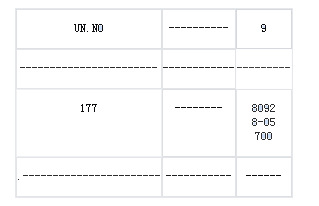
In line with the use of the IMDG Code ", the International Maritime Organization (IMO) has published a ship carrying dangerous goods emergency measures (referred to as" contingency table "EMS) and incidents involving dangerous goods, medical first aid measures to the Guide (referred to as" Medical First Aid Guide "MFAG), both essential information for the shipping of dangerous goods.
A. "contingency table" EMS main content should be equipped with special emergency equipment in the event of accident should be carried out emergency preparedness and goods in dealing with missing and fire measures.
B. "Medical First Aid Guide MFAG the main content including the shipment of dangerous goods, medical guidance, personnel poisoning, a harbinger of injury and symptoms, first aid and diagnostic, emergency disposal methods.
9. The responsibility of the shipper of dangerous goods: the shipper, including the contracting shipper and delivery of the shipper. A proper packing of goods. To make the marking and labeling of dangerous goods in the official name and nature, and should take preventive measures written notification to the carrier so-called obligation to notify. (This obligation is at shipment of the goods or before the issuance of bills of lading, agreed to accept the transport of dangerous goods, agrees to accept the transportation risk, high freight carrier transport risk on the price) A. The shipper perform dangerous goods the obligation to declare, even if the shipper do not know or should know that the goods hazardous nature, is also considered a shipper known of the dangerous nature of the goods. (strict liability) B. The shipper of dangerous goods notification obligations and guarantee responsibility shipper's statutory obligations and liability of breach of this obligation, not because of the transfer of the bill of lading transferred to the consignee, or bill of lading holder. shipper shall not hold the bill of lading liability as an excuse.
1, checked when the dangerous goods manual provided with the consignment note in English or dangerous goods technical specifications of a type number of copies should name, aliases, molecular formula, properties, transport considerations, first aid measures, fire fighting methods for the port, ship loading and unloading, transport of dangerous goods reference.
2, the consignment must be accompanied by the examination and approval by the harbor superintendency administration, "the packaging of dangerous goods safety appropriate transport declaration (referred to as: cargo declaration), the ship agent with the ship by virtue of the declaration (goods to declare) again shall acquire ships carrying dangerous goods declaration form (referred to as: cargo declaration), port authorities must be received by the harbor superintendency administration examination and approval of goods to declare, before allowing the ship carrying dangerous goods.
3, The consignment should be submitted issued by the Import and Export Commodity Inspection Bureau of the IMDG Code in accordance with international maritime requirements for the packaging of dangerous goods certificate "qualified" by the various experimental results. The certificate shall be subject to Port Authority and stamped consent effective port operation area by the Port Authority and stamped certificate agreed dangerous goods into port and check the goods before clearance of the shipment, the harbor superintendency administration with the packaging clearance certificate for the goods declaration (2).
4, containers carrying dangerous goods must fill in English in container shipment of dangerous goods packing certificate "a type number of copies distributed to Port, ship, ship agents and harbor superintendency administration.
5, The outer surface of dangerous goods must display the << International Maritime IMDG >> dangerous goods signs and markings, signs and markings pattern specific need to see the schedule of the IMDG Code; group packaging or containers of dangerous goods, in addition to outside the cargo box to post signs and markings, in the packaging or container external four weeks needed to affix the same with the box contents of the cargo of dangerous goods signage and markings.
6, exports to the U.S. or in the United States for transshipment of dangerous goods, shipping should be provided in Chinese and English "dangerous goods safety information card (referred to as: MSDS) for a duplicate by the shipping agent to the carrier at U.S. ports for the record. Dangerous goods safety information card is required to fill: an overview of hazards composition, physical properties, fire and explosion data, health hazard data, reactivity, infiltration overflow, special protective measures, special methods of prevention and other nine elements.
7, tank container shipment of dangerous goods in bulk, must provide a certificate of inspection of tank containers.
8, the United States, the shipment of dangerous goods or transport of dangerous goods in Hong Kong, also need to add a << International Maritime IMDG >> recommended "dangerous goods declaration.
Handled the consignment of dangerous goods:
1, dangerous goods consignment booking must be different types of hazardous characteristics versions and consignment note for booking with the ship, in order to ship dangerous goods according to various characteristics requirements in accordance with the isolation of the << International Maritime IMDG >> respectively, stowage and transport to safety. For example: a letter of credit and contract shipment oxidizer, flammable liquids and corrosive substances, three different types of goods, the consignment must be in accordance with the three different types of dangerous goods, respectively, versions and three child care single cut can not be a The consignment note at the same time the nature of the consignment three kinds of incompatible goods; Otherwise, the vessel will be three incompatible dangerous goods loaded with three different types of incompatible goods can easily contact with each other, chemical reaction caused by combustion, explosion, causing the accident. If the container transport, avoid incompatible dangerous goods are loaded in the same container.
2, of the versions and of the consignment note. In addition to the need of general cargo (such as: the port of destination, Marks, consignee, notify the person, product name, weight, size, number, etc.) outside the dangerous goods consignment note must increase the following seven:
A. Goods name must be the correct scientific name of the chemical or technical name, you can not use the goods people are not familiar with the common name. For example: "bleach or calcium hypochlorite can not be used BLEACHING POWDER, you should use the" arsenic trioxide ".
B. DANGEROUS CARGO words must be marked to attract the attention of the ship and the shipping agent.
C. You must specify the nature and type of dangerous goods. For example: oxidant (OXIDIZING AGENT), and 5.1 class (CLASS 5.1) words, or flammable liquids (INFLAMMABLE LIQUID) and Class 3.2 (CLASS 3.2).
D. must indicate the dangerous number of the United Nations, such as: phosphoric acid as the UN NO.1805.
E. must indicate the << International Maritime IMDG >> page, such as: potassium nitrate transport IMDG CODE PAGE and 5 171.
F. flammable liquids must indicate the flash point, such as: FLASH the POINT 20 degrees Celsius.
G. In addition, required stowage, special requirements must also be specified on the consignment note reference for the stowage of the ship, for example: Deck the goods must be marked DECK the SHIPMENT ONLY; away from fire The goods and heat source, should indicate the AWAY, FROM the FIRE AND the HEAT! and so on.
Transport of dangerous goods should pay attention to the question:
1, should be realistic treatment of the consignment and declaration of dangerous goods, not to fail to report, omission, misstatement, the blind newspaper.
Dangerous goods transport requirements, high tariffs also higher than the ordinary goods. In the case of self-financing, independent accounting, we must consider the accounting costs, reducing expenses, risk factors, should also be considered to ensure the safety of shipping, the two must take into account the actual operation, when the consignment, and indeed there have been a number of shippers or freight forwarders to save on shipping dangerous goods as general cargo consignments practice, there are a number of shippers and freight forwarders to the lack of knowledge and experience of the Transport of Dangerous Goods will ordinary goods as dangerous goods consignment, a waste of the freight, an increase of unnecessary trouble. this phenomenon should be overcome and correct.
A. << international shipping IMDG >> schedule the column names are not necessarily dangerous goods is well known, whether the dangerous goods, should be based on its content, production process, physicochemical properties, endangering the extent of a number of factors to determine, can not simply be measured in order to name.
B. << international shipping IMDG >> schedule, no specific column names, you can not say it is not dangerous goods. IMDG, Wanbao book, can not be all-inclusive, all dangerous goods in the world the entire list. The development of new technologies, new products who have the characteristics of the substance of the dangerous goods, although not specified in the IMDG Code, should be declared as dangerous goods, in order to facilitate safe shipping. declare approach should be based on their material characteristics, according to the provisions of the IMDG category applies, for example new product features as a flammable liquid, we should be determined in accordance with its closed cup flash point of the number of its category, a closed cup flash point of 20 ° C, the 3.2 class not listed combustibles. toxic substances in accordance with the LD50 of the toxic form volume, by category sets to do.
C. In addition to the International Maritime IMDG >> << that each country has its own IMDG IMDG regulations in order to respect each country for the substance of the dangerous goods, exports of this country, even if the << International Maritime IMDG >> no such material column names should also be declared as dangerous goods. For example, China's exports of oxalic acid to the United States, China is not as dangerous goods, international maritime dangerous rail >> << no such column names, but is classified as dangerous goods in the United States IMDG transportation must be reported in accordance with the Dangerous Goods Otherwise, U.S. ports will not discharge, or a fine.
(2) in strict accordance with the relevant provisions of the port to handle the packing of dangerous goods and the relevant procedures.
Ministry of Transportation has many provisions on the handling, transportation of dangerous goods, the ports of the law enforcement agencies to the harbor superintendency administration. Shanghai harbor superintendency administration of the following two provisions, shippers, freight forwarders and ship agents, carriers are required to unswervingly follow the handle:
A. Handle the packaging of dangerous goods safety for transport to declare a single "and" ship carrying dangerous goods declaration form, "the declaration must be accepted over the harbor superintendency administration professional training and pass an examination, to obtain full-time filing a certificate to declare member.
B. Container stuffing location of dangerous goods must be approved after the harbor superintendency administration of the audit, the need for dangerous cargo container monitoring equipment to members, supervise the installation member must go through the harbor superintendency administration of professional training and passed an examination to obtain a certificate. Containers carrying dangerous goods is regulated by a statement of the packing point-way shall acquire the packaging of dangerous goods safety for transport by sea declaration form goods declaration and container packing is completed, the monitoring equipment are required to containerized dangerous goods packing certificate " to sign, and promptly sent to the harbor superintendency administration for future reference. Packing point and the signature must match, and the harbor superintendency administration within the record to avoid unnecessary trouble.
3, a ship carrying dangerous goods must have certain conditions, particularly the shipment full of dangerous goods by ship must have a certificate of inspection of the ship regulatory authorities.
Highly dangerous goods, means CLASS1, CLASS2, CLASS3.1, and CLASS5.2 and CLASS7 checked in advance to deal with the ship whether or transport by a clear understanding to avoid with the ship after the withdrawal of the customs and delays in shipping schedules.
4. Transshipment port in the special provisions:
At present, many goods transhipped in Hong Kong and Singapore, two ports out of transit of dangerous goods have special regulations and requirements, many varieties prohibits transhipment. Where the transport of dangerous goods of more than two ports, before the turnover of the contract should be the shipping companies concerned to inquire about the possibility of transshipment of two Hong Kong in order to prevent unnecessary breach of contract.
Four countries IMDG special provision:
1, Hong Kong:
A. Required by the Government of Hong Kong into the 50 kinds of dangerous chemicals to produce chemical weapons, Hong Kong or in transit in Hong Kong prior to the relevant authorities in Hong Kong, into the product visa. Otherwise, it does not allow loading and unloading in the port, and offenders will be fine or a fine of 50 kinds of dangerous goods as follows:
<table width="685" border="1" align="center" cellpadding="3" cellspacing="1" bgcolor="#000000">
<tr>
<td width="136" bgcolor="#FFFFFF"><div align="center">1. The sulfur diethylene glycol<br />
</div></td>
<td width="161" bgcolor="#FFFFFF"><div align="center">14.3 quinine ring alcohol<br />
</div></td>
<td width="183" bgcolor="#FFFFFF"><div align="center">27. Ethyl phosphorus usions two fluorine<br />
</div></td>
<td width="166" bgcolor="#FFFFFF"><div align="center">40. A cyanide<br />
</div></td>
</tr>
<tr>
<td bgcolor="#FFFFFF"><div align="center">2. Phosphorus cinnamyi chloride<br />
</div></td>
<td bgcolor="#FFFFFF"><div align="center">15.2 uncle ethanol<br />
</div></td>
<td bgcolor="#FFFFFF"><div align="center">28. A bmi was phosphorus two chlorine<br />
</div></td>
<td bgcolor="#FFFFFF"><div align="center">41. Currently, potassium<br />
</div></td>
</tr>
<tr>
<td bgcolor="#FFFFFF"><div align="center">3. Methyl phosphate two methanol<br />
</div></td>
<td bgcolor="#FFFFFF"><div align="center">16. Uncle benyi methadone<br />
</div></td>
<td bgcolor="#FFFFFF"><div align="center">29. M.N two YiBingJi B amino ethanol<br />
</div></td>
<td bgcolor="#FFFFFF"><div align="center">42. Ammonium currently<br />
</div></td>
</tr>
<tr>
<td bgcolor="#FFFFFF"><div align="center">4. Methyl phosphate methylene chloride<br />
</div></td>
<td bgcolor="#FFFFFF"><div align="center">17. Two benzene methyl alcohol<br />
</div></td>
<td bgcolor="#FFFFFF"><div align="center">30. Methyl ethyl two phosphite<br />
</div></td>
<td bgcolor="#FFFFFF"><div align="center">43. Sodium fluoride<br />
</div></td>
</tr>
<tr>
<td bgcolor="#FFFFFF"><div align="center">5. Trichloride<br />
</div></td>
<td bgcolor="#FFFFFF"><div align="center">18. WuLiuHuaErLin<br />
</div></td>
<td bgcolor="#FFFFFF"><div align="center">31. Ethyl dimethyl phosphoric acid<br />
</div></td>
<td bgcolor="#FFFFFF"><div align="center">44. Currently, sodium<br />
</div></td>
</tr>
<tr>
<td bgcolor="#FFFFFF"><div align="center">6. Trimethyl phosphite<br />
</div></td>
<td bgcolor="#FFFFFF"><div align="center">19. Two different c ammonia<br />
</div></td>
<td bgcolor="#FFFFFF"><div align="center">32. Ethyl times p et 2 fluorine<br />
</div></td>
<td bgcolor="#FFFFFF"><div align="center">45. Sodium cyaniding<br />
</div></td>
</tr>
<tr>
<td bgcolor="#FFFFFF"><div align="center">7. Two thionyl chloride<br />
</div></td>
<td bgcolor="#FFFFFF"><div align="center">20.3 and 1 methyl nitrogen heterocyclic ethane<br />
</div></td>
<td bgcolor="#FFFFFF"><div align="center">33.3 quinine ring ketone<br />
</div></td>
<td bgcolor="#FFFFFF"><div align="center">46. Diethylamine and ethanol<br />
</div></td>
</tr>
<tr>
<td bgcolor="#FFFFFF"><div align="center">8. Currently,<br />
</div></td>
<td bgcolor="#FFFFFF"><div align="center">21. MN two isopropyl B amino chlorinated ethane<br />
</div></td>
<td bgcolor="#FFFFFF"><div align="center">34. A bmi of phosphoric acid methyl two fluorine<br />
</div></td>
<td bgcolor="#FFFFFF"><div align="center">47. The method<br />
</div></td>
</tr>
<tr>
<td bgcolor="#FFFFFF"><div align="center">9. Currently,<br />
</div></td>
<td bgcolor="#FFFFFF"><div align="center">22. MN two isopropyl B amino ethanol<br />
</div></td>
<td bgcolor="#FFFFFF"><div align="center">35. Phosphite two ethyl ester<br />
</div></td>
<td bgcolor="#FFFFFF"><div align="center">48. Dimethyl phosphite<br />
</div></td>
</tr>
<tr>
<td bgcolor="#FFFFFF"><div align="center">10. Describes the<br />
</div></td>
<td bgcolor="#FFFFFF"><div align="center">23. Phosphoric acid ethyl ester b<br />
</div></td>
<td bgcolor="#FFFFFF"><div align="center">36. Phosphite three ethyl ester<br />
</div></td>
<td bgcolor="#FFFFFF"><div align="center">49. Methyl phosphate usions methylene chloride<br />
</div></td>
</tr>
<tr>
<td bgcolor="#FFFFFF"><div align="center">11. A fluoride<br />
</div></td>
<td bgcolor="#FFFFFF"><div align="center">24. M.N dimethyl amino two ethyl ester<br />
</div></td>
<td bgcolor="#FFFFFF"><div align="center">37. Three chlorinated landed gentry<br />
</div></td>
<td bgcolor="#FFFFFF"><div align="center">50.0 ethyl b 2 c ammonia methyl b di-n-propyl phosphite<br />
</div></td>
</tr>
<tr>
<td bgcolor="#FFFFFF"><div align="center">12. Describes the hydrochloric acid<br />
</div></td>
<td bgcolor="#FFFFFF"><div align="center">25. A bmi of phosphoric acid ethyl two chlorine<br />
</div></td>
<td bgcolor="#FFFFFF"><div align="center">38. ErBenYiChunSuan<br />
</div></td>
<td bgcolor="#FFFFFF"><div align="center"></div></td>
</tr>
<tr>
<td bgcolor="#FFFFFF"><div align="center">13. Triethanolamine<br />
</div></td>
<td bgcolor="#FFFFFF"><div align="center">26. Ethyl phosphorus usions methylene chloride<br />
</div></td>
<td bgcolor="#FFFFFF"><div align="center">39. Pcl.sub.5<br />
</div></td>
<td bgcolor="#FFFFFF"><div align="center"></div></td>
</tr>
</table>
B. Hong Kong Government also stipulates that the export license before allowing access and transit in Hong Kong, such as morphine, cocaine, over one hundred kinds of dangerous drugs must be completed after the Hong Kong Health Department and the Trade Department to apply for entrance. Otherwise, goods will be confiscated, the carrier will be prosecuted, fined or in jail. The majority of the over one hundred kinds of dangerous drugs for toxic substances.
2. Hamburg and Rotterdam: Port regulations and out of dangerous goods, packaging, marking and IMDG Code must comply with the International Maritime IMDG goods packaging surface to be printed packaging mark of the IMDG regulations. Such as: 1A1/Y1.2/95 N/310060036; Otherwise, you can not discharge or a fine.
3. Thailand Bangkok Dangerous Goods Regulations: Where to enter the port of discharge 270 kinds of inflammable and explosive dangerous goods, the goods must be directly at the side removed; thousands of other semi-risk dangerous goods must be within three days after discharge of the ship put away the goods otherwise the goods will be confiscated, so the bill of lading must show consignee's full address, contact person, phone, fax, etc., in order to avoid delay in notification.
4. The secret lu horse, tara Hong Kong Dangerous Goods Regulations not these three categories: << International Maritime IMDG >> CLASS1.1, CLASS1.2, CLASS1.3 three sub-categories explosive dangerous goods can not be at the port loading and unloading. dangerous goods transported to the port.
5, Manila, the Philippines, the provisions of the Dangerous Goods: port regulations, the following dangerous goods must be discharged at the side of the consignee: glacial acetic acid, activated carbon, phosphoric acid, hydrogen peroxide, insurance powder, so the bill of lading the consignee must set out the name, address Contact telephone, fax, etc.
6. East African port of Mombasa, Tanga, Dar es Salaam and other dangerous goods provisions: three port authorities require that all dangerous goods to the consignee at the side and stamped with the relevant provisions in the bill of lading
7, Dangerous goods in the United States successfully pass off: dangerous goods, storage, handling and transport of flammable, explosive, toxic, corrosive and radiation such as the special nature of the slightest mistake, the personal safety of shipping and social environment will cause great harm. Countries around the world have strict regulations on the import and export of such goods, especially the United States, management is more strict and more demanding. The country since 1991, announced the implementation of import and export of dangerous goods transport regulations, such as violation of the regulations will be punished by a fine of 10,000 dollars. More than five years, there are many ships and cargo owners lack of understanding of regulations, impose a fine at U.S. ports. The relevant provisions of the content and practices described below, for reference.
State Department of Transportation of dangerous goods entry requirements, U.S. Department of Transportation provides that where shipped to the United States and in transit or transit of dangerous goods shall do the following:
(1) the waybill, bill of lading on the manifest must indicate the emergency telephone number of the shipper, and staff regardless of holidays on duty 24 hours, ready to answer the query of the United States.
(2) the waybill, bill of lading, the name of the cargo on the manifest must provide detailed chemical dangerous goods technical name, but not use common names. For example: calcium hypochlorite or bleaching powder, BLEACHING POWDER, you should use calcium hypochlorite CALCIUM HYPOCHIORITE.
(3) the shipper by the carrier transmitted to the U.S. port authorities and to provide full details of the emergency handling of dangerous goods, dangerous goods data card, or U.S. Department of Transportation emergency response guidance.
(4) container transport, each 20 feet inside the fitted maximum limit of goods and weighing 38,000 lbs; every 40 feet of the goods inside the maximum limit of weight of 42,000 lbs. The box must liner, tied properly; four sides of the goods inside and outside the box must be posted prominently dangerous goods signs and markings.
The material safety data card filled out. Safety information card, English as a MATERIAL SAFETY DATA SHEET, similar to our current use of "dangerous goods technical specifications, but the content is more detailed, more demanding and more comprehensive. It has a 9-part, each part there are a number of small items, required to fill out. Part 9:
(1) Overview. Mainly refers to the name of the dangerous goods classification, formula, etc., and the manufacturer's name, address, telephone and so on. The various elements required to complete a clear, can not be omitted, so that the United States at any time. CAS NO chemicals registration number of the American Association of chemicals, such as: oxalic acid CAS NO :144-62-7 Barium Fluoride CAS NO :7787-32-8, this writing may require the importer.
(2) an element of risk. Shall dangerous goods, the main ingredient of various components of the proportion set out in detail. Toxic substances need to indicate toxicity. For example: the rat experiment semi-lethal dose data.
(3) physical properties. Refers to the physical and chemical properties of dangerous goods, which include Buddhism point, vapor density, evaporation rate and volatile proportion
(4) fire and explosion data. Includes the U.S. Department of Transportation of dangerous goods classification, within a point of flammable liquids, explosive limit, the risk of accidental fires and explosions, and fire extinguishing tools and special fire fighting measures.
(5) information on health risks. Dangerous goods harmful to human health, such as the boundary of the limits of the human body orally or by skin contact, excessive exposure to light exposure risks, hazards, first aid measures.
(6) reactions. Refers to dangerous goods, chemical reactions, the stability of the items, incompatibility, toxic decomposition products, harmful polymers.
(7) infiltration overflow process. Refers to the damage leakage of dangerous goods packaging or packaging kept loaded too full, the lid loose liquid overflow of counter-measures and disposal methods.
(8) special protective measures. Protective measures refer to the respiratory system, eye protection, ventilation requirements, protective gloves and other protective equipment.
(9) special methods of prevention. Means of preventive measures in the handling, storage, transportation precautions and other circumstances. 9 must fill out a complete and indispensable. United States is the legal system is very strict, very strict management of dangerous goods, the contents of the safety information card in the handling, transportation, operation and handling basis when the accident occurred, fill out this card must be prudent and careful take full account of the authoritative technical and legal factors, as a preventive measure.
Dangerous goods classification and characteristics:
1. Categories: explosives (EXPLOSIVES) refers to this class of chemicals in the outside world under the action (collision, backlog, heat, etc.), the occurrence of a violent chemical reaction, and instantly generate a lot of gas and heat, the surrounding pressure were sharply rising, on the surrounding environment serious damage to the goods; including the overall risk of explosion, but with the projectile, burning and small explosions dangerous goods. Category: 1.1: detonate the explosives, detonators, etc.; 1.2 class fuses and ammunition, flares, and rocket engines; 1.3 combustion ammunition, smoke screen drugs, C-type fireworks; 1.4 exercises grenade, the safety fuse 1.5 E-type B-type detonating agent
2. Class 2: Gases: This class of chemicals are compressed, liquefied or dissolved under pressure gases. Characteristics: explosive characteristics: asphyxia, anesthesia and toxicity classification: Class 2.1 flammable gases: hydrogen, methane, acetylene 2.2 categories: non-combustible gases: oxygen, air, carbon dioxide, etc.; Class 2.3: toxic gases: cyanide gas, phosgene, sulfur dioxide, etc.
3. Class 3: flammable liquids class of chemicals is the experimental 61 ° C closed cup (equivalent to the open cup 65) or below temperature emit steam mixed with air near an open flame may issue a flash liquid characteristics of 1: volatile and flammable explosion) (In case of acid or oxidant properties: explosive characteristics: narcotic and toxic classification 3.1: Low flash point class of liquid (flash point less than -18 degrees), acetaldehyde, acetone, gasoline diluent such as 3.2: the flash point (-18 to 23 degrees) Class liquid, naphtha, industrial alcohol, benzene 3.3: High flash point class of liquid (23 --- 61 degrees) pine fragrance, printing inks and butanol
4. Flammable solids, emit flammable gases liable to spontaneous combustion and wet substances of this class of chemicals refers to the program classification of substances in the transport of explosives, flammable or easily cause a fire of Class 4.1: flammable solids (Yi lit) aluminum powder, magnesium powder, cotton, hemp, picric acid, trinitrobenzene, sulfur, celluloid film, etc. 4.2: liable to spontaneous combustion, such as activated carbon, fish meal, white phosphorus 4.3: wet the release of flammable gases such as carbonized calcium (calcium carbide), phosphine, sodium, potassium, lithium, etc.
5, Oxidizers and organic oxides of this class of chemicals characteristics: strong oxidizing toxic and corrosive. To heat and impact, friction-sensitive classification Class 5.1: oxidants: potassium permanganate, sodium peroxide, calcium hypochlorite (bleach) Class 5.2: Organic peroxides: oxidation stupid acyl peroxide carbonate, benzophenone fat
6, Class 6.1 toxic substances and infectious substances classified toxic substances: LD50 (median lethal dose, per kg of animal weight used poison dose mg / kg units) LC50 (median lethal concentration, 1 hour, mg / L), the smaller the poison more large; such as: arsenic and arsenic compounds, potassium cyanide, sodium cyanide / / mercury, mercuric oxide, bromine and acetone / / six-chlorophenol, oxalic acid ethyl ester, dichloro ether and so on. The toxicity classification is as follows:
<table width="629" border="1" align="center" bgcolor="#000000" cellpadding="3" cellspacing="1">
<tr>
<td width="118" bgcolor="#FFFFFF"><div align="center">Dangerous level</div></td>
<td width="163" bgcolor="#FFFFFF"><div align="center">Swallowed toxic LD50 (mg/kg) </div></td>
<td width="162" bgcolor="#FFFFFF"><div align="center">contact with skin toxic LD50 (mg/kg)</div></td>
<td width="147" bgcolor="#FFFFFF"><div align="center">Breathing dust, smoke toxicity LD50 (mg/kg)</div></td>
</tr>
<tr>
<td bgcolor="#FFFFFF"><div align="center">Highly dangerous</div></td>
<td bgcolor="#FFFFFF"><div align="center">Less than, equal to 5</div></td>
<td bgcolor="#FFFFFF"><div align="center">Below, equal to 40</div></td>
<td bgcolor="#FFFFFF"><div align="center">Below, be equal to 0.5<br />
</div></td>
</tr>
<tr>
<td bgcolor="#FFFFFF"><div align="center">Serious toxicity dangerous</div></td>
<td bgcolor="#FFFFFF"><div align="center">More than 5-50</div></td>
<td bgcolor="#FFFFFF"><div align="center">More than 40-200</div></td>
<td bgcolor="#FFFFFF"><div align="center">More than 0.5- -2</div></td>
</tr>
<tr>
<td bgcolor="#FFFFFF"><div align="center">Smaller toxic dangerous</div></td>
<td bgcolor="#FFFFFF"><div align="center">Solid: more than 50-200</div></td>
<td bgcolor="#FFFFFF"><div align="center">Solid: more than 200-1000</div></td>
<td bgcolor="#FFFFFF"><div align="center">Solid: 2 above-10</div></td>
</tr>
<tr>
<td bgcolor="#FFFFFF"><div align="center">Smaller toxic dangerous</div></td>
<td bgcolor="#FFFFFF"><div align="center">Liquid. More than 50-500</div></td>
<td bgcolor="#FFFFFF"><div align="center">ditto</div></td>
<td bgcolor="#FFFFFF"><div align="center">ditto</div></td>
</tr>
</table>
Substances Class 6.2: infectious substances can cause human or animal disease microorganisms or their toxins which prohibit shipping in China
7. Radioactive substances: since the beginning of irradiation and external irradiation two
8. Corrosive substances: chemicals in this class refers to the chemically active metals (steel, iron, aluminum, zinc, tin), and organic matter (wood, paper, fiber, skin, fat, etc.) and animal and plant body chemical reaction, so that metal surface destruction of organic matter charring or burning of solid or liquid organic organisms chemical burns Category: nitric acid, sulfuric acid, potassium hydroxide, sodium oxide, potassium permanganate, etc.
9. Other dangerous goods: not included in the above but there are hazardous substances, such as: dry ice (solid carbon dioxide), self-inflatable life-saving equipment, type B, ammonium nitrate fertilizers, and other six. Identification and marking of dangerous goods: 1. Identification of dangerous goods: Maritime Dangerous Goods must be indicated in the documents of the shipment of dangerous goods consignments by the proper shipping name (the PROPER is SHIPPING NAME that is, the correct scientific name), class and UN number (UN.NO.); in each marked with the proper shipping name of its contents were packages of dangerous goods and paste that dangerous goods category, the risk of eye-catching durable signs so that the dangerous goods and hazardous properties easily identifiable in order to cause the full attention and vigilance , giving the necessary attention and take appropriate precautionary measures to ensure the safe transport of dangerous goods. a sign of dangerous goods: In order to facilitate the identification of dangerous goods and the risk of the form of another mark, label (or labels pattern) and signs of the points. (1) Tags: brief words or symbols of the index note on the package of dangerous goods (the correct scientific name, the type of goods CLASS4.1, etc.) (2) Tags: refers to the use of appropriate materials coated distinctive colors, patterns and symbols diamond-shaped sign, size not less than 100mmX100mm. (indicate the nature and pattern of dangerous goods such as flammable, explosive, and the IMDG Code level) marking and labeling to be durable, maintains a permanent, that is soaked in seawater not fall off after three months, must be legible. times dangerous goods attached followed by dangerous vice label. receive in the Port Authority. (3) signs: to enlarge the label (not less than 250mmX250mm), if the transport unit (such as containers, trucks, portable tanks, etc.) outside can not clearly identify the dangerous goods, and paste the appropriate signs should be in the exterior side and end of the transport unit, to warn people it contains dangerous goods.
Packaging of dangerous goods: (1) Class 2 and Class 7 dangerous goods other than packaging: (a) General requirements: meet the general requirements of the IMDG Code "on the packaging. A. The quality is good, with sufficient strength and more good gaskets airtight B. packing surface and packaging, the adsorption material is inert and compatible with the nature of the cargo to be loaded. C. packaging and composite packaging must comply with the requirements of the packaging performance experiments have experimental proof of passing the "packaging a certificate of inspection." D. packaging the outer surface does not allow contaminated with any harmful substance. E. The secondary container to be protected as the dangerous goods loaded by cleaning, handling, treatment (2) Packaging Category: AI packing: can hold a great danger of the goods B.II packing: can hold a medium-risk cargo C.III packing: can hold low-risk goods. (3) packing type code: the provisions of the IMDG Code ", each package with the corresponding code, said the type of packaging, materials and structural characteristics. code is generally of three parts (two parts): A. the top with an Arabic numerals the type of packaging: 1 ---- drums 2 --- barrels 3 ---- tank, 4 --- Box 5 --- bags, 6 ---- composite packaging B. subsequently (p. 2) with one or two uppercase Latin alphabet, said packaging material (composite packaging with two capital letters, followed by that of the inner and outer materials of combination packaging with only one letter said packaging material). : ---- Steel ---- aluminum, C --- natural wood, D ---- plywood, F ---- renewable wood, G ---- fiberboard, H ---- plastic, L --- textile, M ---- paper P ---- glass, porcelain or stoneware C. last one is an Arab figure, said the special structure of a certain type of packaging, performance (4) packaging mark: who meet the the IMDG Code, the requirements of the packaging production, and performance test used in packaging, in accordance with the IMDG Code, should be durable and clearly marked with the following sample expressed. New U-4G/Y145/S/83 repair U 1A1/Y1.4/160/83 N NL/VL824 N NL/RB/85RL A) UN ----------- United Nations packaging symbol B) 4G The capital letters (or 1A1) ----- package type code C) Y145 (Y1.4) ----- by the experimental determination of the type of packaging, such as X ----- Part I II, packing group III, Y----- applies to Part II, III packing, and Z --- Class III package only if followed by S, said the maximum gross weight KGS (145); as it then pick the Arabic numerals ( 160), 1.4, said the relative density of liquid (less than 1.2, can be omitted), 160 experimental pressure (Kpa) D) 83 ---- packaging manufacturers year after the two E) NL ---- two of the countries specify the tag F) year VL824 ---- the name of the manufacturer's or competent authority of the packaging identification symbol G), BR --- repair person's name or symbol H) 85RL ---- repair median, R --- said repair, packaging addition of L --- by the anti-leakage experiment 1H (plastic drums) or 3H (plastic containers), packaging shall be in Tables discoid manufacture month. (2) Class 2 dangerous goods Packaging: This category includes the compressed state, liquid state and the state transport of gases dissolved under pressure, need special pressure container packaging (carbon steel or alloy steel cylinders, steel alloy or aluminum containers, etc.) must be before the container to use hydraulic and pneumatic experiments. in accordance with 15 ° C and pressure limits are divided into low-voltage, medium voltage, high pressure and pressure vessels.
8. The use of the IMDG Code "and custody: 1. Check for the total index according to the correct scientific name of the goods: goods the former with the N-or lowercase letter prefix lookup, not be considered. Such as: formic acid (HYDROGEN CARBOXYLIC ACID) to check the letter H, in accordance with the IMDG Code Page 8092, you can find the schedule of the formic acid are as follows:
<table width="699" border="1" align="center" bgcolor="#000000" cellpadding="3" cellspacing="1">
<tr>
<td width="91" bgcolor="#FFFFFF"><div align="center">Material or items (substanceor article)</div></td>
<td width="98" bgcolor="#FFFFFF"><div align="center">"The international crisis rules" the page number (IMDGCODE page)</div></td>
<td width="46" bgcolor="#FFFFFF"><div align="center">The UN code (UN. NO)</div></td>
<td width="78" bgcolor="#FFFFFF"><div align="center">Category (class)</div></td>
<td width="85" bgcolor="#FFFFFF"><div align="center">Packaging categories (Packaging Group)</div></td>
<td width="84" bgcolor="#FFFFFF"><div align="center">Deputy danger signs (Subcidiary Risk Labels)</div></td>
<td width="70" bgcolor="#FFFFFF"><div align="center">Emergency table code (EMS NO.)</div></td>
<td width="72" bgcolor="#FFFFFF"><div align="center">The emergency medical treatment guidelines Numbers (MFAG table NO)</div></td>
</tr>
<tr>
<td bgcolor="#FFFFFF"><div align="center">ACID (HYDROGSEN CARBOXYLIC ACID)<br />
</div></td>
<td bgcolor="#FFFFFF"><div align="center"></div></td>
<td bgcolor="#FFFFFF"><div align="center"></div></td>
<td bgcolor="#FFFFFF"><div align="center"></div></td>
<td bgcolor="#FFFFFF"><div align="center"></div></td>
<td bgcolor="#FFFFFF"><div align="center"></div></td>
<td bgcolor="#FFFFFF"><div align="center"></div></td>
<td bgcolor="#FFFFFF"><div align="center"></div></td>
</tr>
</table>
The schedule sets out the characteristics of the material, packaging, labeling, stowage, isolation and precautions. Check the ID index according to the UN number of the goods: the three numbers on the left, said the UN number of the first three numbers, the upper horizontal bar is the fourth digit of the number of the United Nations, the table below. Such as formic acid as 1779, Charles 177, and then found 9 of the cross bar, the cross-bar, respectively IMDG page 8092, the number of "contingency table" 8-05, First Aid Guide Form No. 700
In line with the use of the IMDG Code ", the International Maritime Organization (IMO) has published a ship carrying dangerous goods emergency measures (referred to as" contingency table "EMS) and incidents involving dangerous goods, medical first aid measures to the Guide (referred to as" Medical First Aid Guide "MFAG), both essential information for the shipping of dangerous goods.
A. "contingency table" EMS main content should be equipped with special emergency equipment in the event of accident should be carried out emergency preparedness and goods in dealing with missing and fire measures.
B. "Medical First Aid Guide MFAG the main content including the shipment of dangerous goods, medical guidance, personnel poisoning, a harbinger of injury and symptoms, first aid and diagnostic, emergency disposal methods.
9. The responsibility of the shipper of dangerous goods: the shipper, including the contracting shipper and delivery of the shipper. A proper packing of goods. To make the marking and labeling of dangerous goods in the official name and nature, and should take preventive measures written notification to the carrier so-called obligation to notify. (This obligation is at shipment of the goods or before the issuance of bills of lading, agreed to accept the transport of dangerous goods, agrees to accept the transportation risk, high freight carrier transport risk on the price) A. The shipper perform dangerous goods the obligation to declare, even if the shipper do not know or should know that the goods hazardous nature, is also considered a shipper known of the dangerous nature of the goods. (strict liability) B. The shipper of dangerous goods notification obligations and guarantee responsibility shipper's statutory obligations and liability of breach of this obligation, not because of the transfer of the bill of lading transferred to the consignee, or bill of lading holder. shipper shall not hold the bill of lading liability as an excuse.